Does Growth Pay for Itself? Rethinking the Question
Understanding the Cost of Growth
September 5, 2025 – PALM COAST, Fla. – The question “Does growth pay for itself?” is often asked as communities expand. Providing more public services for a growing population brings significant expenses. Yet, even in the absence of growth, the costs to maintain infrastructure—roads, utilities, parks, fire and police departments, and libraries—naturally rise faster than the rate of inflation.
Rather than asking if growth pays for itself, it may be more accurate to consider whether population growth helps offset the ever-increasing costs of government facing existing residents. In many respects, it does.
Homeowner Associations (HOA) and Community Development Districts (CDD)
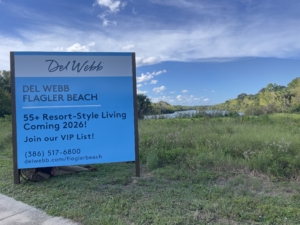
New Development Site
In Florida and other states experiencing growth, municipalities generally no longer accept responsibility for maintaining new development infrastructure once construction is complete. Developers bear the cost of building common areas, streets, stormwater systems, streetlights, sidewalks, and amenities—expenses that are ultimately passed on to those purchasing new homes.
New development agreements now require the formation of entities like homeowner associations or community development districts to maintain infrastructure for the community indefinitely. These organizations assess property owners, often charging several hundred dollars per month.
An exception exists for water and sewer systems: developers (and thus new homeowners) pay for construction, but municipalities typically take over these systems after completion without compensating the developer. These systems then become valuable sources of ongoing municipal revenue.
Residents of new communities do not receive tax breaks for their additional costs. They pay for their private stormwater management system, which serves their entire development, and are still taxed for municipal-wide stormwater maintenance. By using their own amenities, they reduce demand on public parks and trails while continuing to pay property taxes to support municipal facilities.
Impact Fees
Each single-family building permit in Palm Coast generates over $25,000 in impact and connection fees for the city (not including school district fees). These fees are about 25 times greater than the annual property tax paid by non-homesteaded homeowners, and roughly 50 times that paid by homesteaded city residents. Impact fees are earmarked for capital projects, which benefit the entire community—not just newcomers.
Development agreements often include commitments from the developer, such as new turn lanes, traffic signals, donated school and park sites, well sites, conservation easements, etc. The resulting advantage for long-term homeowners is significant.
Homesteading and Save Our Homes
New Florida homeowners encounter the state’s Homestead and Save Our Homes laws. The January after their purchase, their home’s value is reassessed at “True Value,” and eligible homeowners receive a homestead exemption, setting the Taxable Value equal to the Assessed Value.
In subsequent years, Save Our Homes limits assessment increases to the lower of the Consumer Price Index or 3%. This creates a growing gap between True Value and Assessed Value, thus reducing Taxable Value. In Palm Coast, non-homesteaded property owners pay nearly twice as much city property tax as homesteaded owners.
Since all residents have access to the same public services, the Save Our Homes tax savings amount to a form of subsidy. City analysis from 2023 showed that 75.3% of homes were homesteaded, but these accounted for only 62.8% of property taxes paid.
Growth in Taxable Value and Home Prices
New construction has added $2.9 trillion to Flagler County’s taxable property value since 2022. New construction is the true measure of population growth. When an existing homesteaded Floridian buys a new construction home, they may port their Save Our Homes savings to the newly constructed home. However, the transaction still frees up the existing home for a freshly arrived Floridian. The sale of the existing house will still trigger a reset of the Assessed Value to the Just Value, raising the Taxable Value.
Flagler County’s total Just Value has increased by 20.4% since 2022, rising from $22.5 trillion to $27.1 trillion (2025). Meanwhile, the Taxable Value jumped 42.5%, from $12.7 trillion to $18.1 trillion. Both rising prices and new construction contributed to the rise.
The median MLS home price in Flagler County climbed from $240,000 in 2019 (pre-COVID) to $365,000 in 2024. Those with homesteaded homes in 2019 saw their equity rise by an average 52%. During those years, homesteaded owners protected by Save Our Homes experienced nominal property tax hikes.
Between 2022 and 2024, the City of Palm Coast’s budget increased by 29.8%, from $238,668,786 to $309,699,522. Even after adjusting for inflation and population growth, the budget still climbed by 16%. Yet the city’s millage rate declined 7.7% during the same period.
Does growth pay for itself? The evidence strongly supports that population growth helps mitigate the growing costs of government, offering real financial benefits for existing Florida homeowners.
Also read: Why Do People Bitch about Florida Property Taxes?
See: Map of existing and planned residential developments in Palm Coast and Flagler County
Leave a Reply
Want to join the discussion?Feel free to contribute!